

Italy can return to growth only if it dares to “choose the denominator,” that is, the GDP of the debt/GDP ratio, productivity, and value creation, and not the numerator, debt.
This is the ultimate meaning of Il futuro non aspetta. Cambiare per (far) crescere (Egea, 2025), the most recent book by Stefano Caselli, Dean of SDA Bocconi School of Management: the country’s restart depends on a cultural and political choice, even before an economic one. After years of resilience and adaptation, Italy must move from defense to offense, freeing its human and financial capital to build real growth. Because – Caselli warns – without growth there are no resources for social cohesion, sustainability, or democracy itself.
The volume opens with an introduction that takes on the tone of a civic manifesto and closes with an epilogue inviting readers to “write a different ending,” entrusting them with the responsibility for change. In the five central chapters, Caselli interweaves economic analysis, strategic vision, and civic passion. He begins with the issue of the relationship between debt and GDP, calling for the €6 trillion in private savings (the country’s greatest resource) to be directed toward Italian enterprises rather than invested in other economic systems. He then reflects on equity capital as an infrastructure for development: finance should not be a mere technical instrument, but a driver of social impact, capable of “connecting value to values.”
At the heart of the book, he addresses the relationship between the State and enterprises, calling for a lighter and more forward-looking industrial policy that rewards those who innovate and grow instead of defending the status quo. He then broadens his perspective to Europe, the last call to build a capital markets union that would make the Union truly competitive, and concludes with a reflection on human capital – school, university, culture – as the foundation of all economic and civic progress.
In Caselli’s vision, finance must once again serve the common good, the State must act as a facilitator rather than an administrator, and Europe must serve as a platform for scale and strategic ambition. Growth, he emphasizes, is not merely an economic variable, but a collective project that requires governance, leadership, and trust in human capital. “Culture,” he writes, “is Italy’s real and profound capital,” and only by investing in education and knowledge can the country face the complexity and speed of the contemporary world.
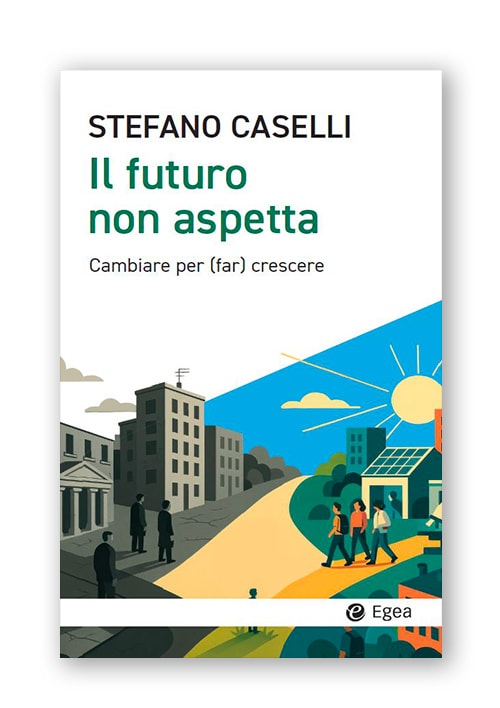
Il futuro non aspetta is a book that speaks to entrepreneurs, policymakers, managers, students, and informed citizens – to those who want to understand how Italy can once again become a leading player on the European and global economic map. Caselli does not offer easy recipes but a direction of travel: to orient resources and intelligence toward growth, through an alliance among the State, the market, and civil society. It is an essay that combines the expertise of an economist with the passion of a civil servant and that invites, with the optimism of reason, readers to believe that the country can truly “write a different ending.”
“Is it possible? Will we make it?” asks Caselli. “The answer is yes, if we first agree on a few fundamental values and then get to work. My ambition, as an Italian, is that our country, for once, may become the laboratory and the example of a kind of growth capable of surprising others, accompanied not only by a steady positive trend in GDP and employment but also by genuine attention, as essential elements of development, to the environment, to enhancing the role of women, to social values, and to well-being, made up of environment, health, and education. Let’s try to be Italian as always, but in a different way.”
- Publisher: EGEA
- Publication Date: 2025
- Pages: 160
- ISBN/EAN: 9791222930855
- Format: Print, E-Pub
STEFANO CASELLI, Dean of SDA Bocconi School of Management, is Full Professor of Finance at Bocconi University, where he holds the Algebris Chair in Long-Term Investment and Absolute Return. He is a columnist for Corriere della Sera.


