
Cycling as a hidden excellence of Made in Italy: the Colnago case
"The Italian code" is a blog on Made in Italy and symbol-intensive industries, coordinated by Gabriella Lojacono.

 When people talk about Made in Italy, the mind immediately turns to fashion, design, automotive manufacturing, or food and wine. Cycling is less frequently considered one of the most significant expressions of Italian industrial excellence. Yet few ecosystems represent so effectively our country's ability to combine nature, territory, tourism, sport, competition, community building, specialized manufacturing, technological innovation, design, and culture. Every spring, millions of people follow the Giro d'Italia along a route that crosses mountains, villages, art cities, and landscapes that embody the very essence of our country. With more than 3,000 kilometers of racing, dozens of stages, and international television coverage reaching hundreds of millions of viewers worldwide, the Giro is not merely a sporting competition: it is an extraordinary platform for promoting territory, tourism, and the Italian lifestyle.
Around cycling, a much broader system develops than simple sports participation. Gran fondos, amateur events, cycling routes, cycling tourism, professional competitions, sports clubs, and enthusiast communities fuel a phenomenon that involves millions of athletes and fans. Cycling is, in fact, one of the few sports capable of combining competition and mass participation, professionalism and popular passion, performance and the discovery of local areas.
It is precisely this ability to bring together sport, nature, wellness, mobility, and local identity that makes the sector particularly interesting from an economic perspective as well. Behind the images of major races lies a highly specialized industrial supply chain that includes bicycles, components, technical apparel, accessories, services, events, and tourism. Although less visible than other symbols of Made in Italy, this ecosystem embodies many of the elements that have made the Italian model famous worldwide: quality manufacturing, continuous innovation, design, product culture, and a strong connection to local territory.
It is by observing this supply chain that a frequently underestimated reality emerges: cycling is not merely a sport or a passion, but one of the most interesting industrial excellences of contemporary Made in Italy.
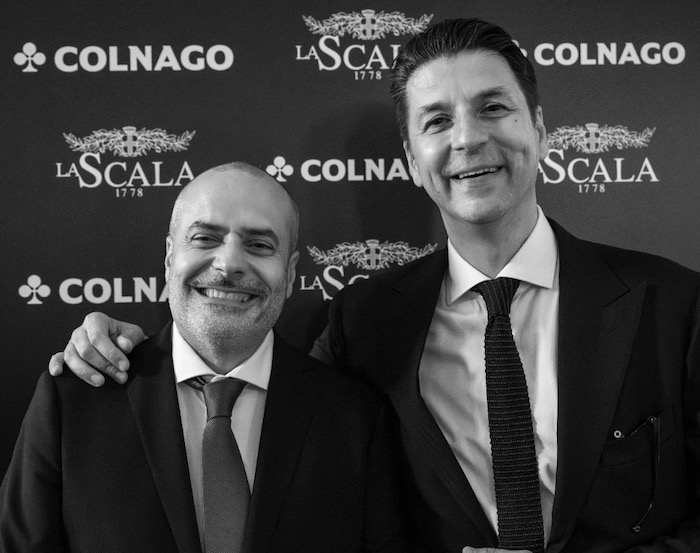
Picture: Manolo Bertocchi, Head of Marketing, and Nicola Rosin, CEO of Colnago
A transformation underway: from volume to value
According to data from ANCMA (the National Association of Bicycle, Motorcycle, and Accessories Manufacturers) and the latest surveys of the Italian bicycle market, the sector is undergoing a particularly interesting phase of transformation. In 2025, the Italian bicycle market recorded a contraction in volumes, with approximately 596,000 bicycles sold (-9.4% compared to the previous year). At the same time, however, domestic production of traditional bicycles grew by 6%, exports increased by 11%, and the sector's trade balance remained strongly positive. Italian cycling therefore continues to generate international value even during a period of slowing domestic demand.
This apparent contradiction tells a story different from that of a market simply facing difficulties. Rather, it suggests a gradual transformation of the sector, where value matters more and more than volume and where competitiveness is measured by the ability to create desirable and distinctive products.
From product to desirability
Looking at the evolution of demand reveals even more interesting signals. Categories more closely associated with everyday use have experienced declining sales, while segments linked to performance and experience have shown greater resilience.
Road and gravel bikes now account for more than 23% of traditional bicycles sold in Italy, a share that continues to grow. Even more significant is their price positioning: roughly three-quarters of road bikes are purchased for more than €2,000, and more than one-fifth exceed €6,000. In the gravel segment, which more than any other reflects contemporary cycling, nearly seven out of ten bicycles are sold for more than €1,500.
This phenomenon goes beyond simple purchasing behavior. As in other iconic Made in Italy sectors, the product is chosen not only for what it does, but for what it represents. Competition is gradually shifting from price to perceived value, from utility to desirability.
In this sense, cycling is following a trajectory similar to the one already observed in fashion, design, and high-end automotive manufacturing.
The Colnago case
It is in this context that the Colnago case becomes particularly interesting.
Founded in 1954 by Ernesto Colnago in Cambiago, just outside Milan, the company has accompanied some of the most important technological and sporting transformations in modern cycling. From steel to carbon fiber, from the first structural innovations to the most recent victories at the highest levels of professional cycling, the brand has evolved while maintaining a strong identity.
In 2020, the Colnago family sold control of the company to international investors from Abu Dhabi. Today, the brand is part of the portfolio of Aurora Vision Group, a holding company led by Melissa Moncada.
For many historic brands, the arrival of international capital represents a risk of homogenization. In Colnago's case, the opposite occurred: the new ownership chose to strengthen the brand's distinctive elements—Italian identity, craftsmanship, performance, and culture—demonstrating how global capital and local identity can not only coexist but reinforce one another.
At the conclusion of the first business plan developed under the new ownership (2021–2025), Colnago surpassed €76 million in revenue, reached levels of operating profitability comparable to those of the most exclusive luxury brands, and further consolidated its international presence. More than a simple growth story, the Colnago case represents an interesting example of how global capital and local identity can be transformed into a sustainable competitive advantage.
Growth has not been pursued through indiscriminate expansion of the product range, but through greater specialization. Today, Colnago focuses exclusively on the drop-bar bicycle segment, structuring its offering around racing platforms such as the V5Rs, V4, and Y1Rs; the prestigious C Series with the C72; the gravel segment with the G4-X; and a heritage line that includes iconic models such as the Steelnovo and the Master. No mountain bikes. No city bikes. No e-bikes.
The production model also reflects this search for balance between exclusivity, quality, and control. Approximately 70% of production follows an assembly-to-order logic, while the remaining 30% is produced on a made-to-stock basis. Average lead times are around three months, demonstrating a preference for quality, customization, and precision over volume maximization.
Craftsmanship also remains a central element of the value proposition. Models such as the C72 and the Steelnovo are still handmade in Italy and can be customized through the Colnago Customizator program, which allows customers to modify finishes and aesthetic configurations. In an industry where standardization often represents the easiest path to growth, Colnago continues to invest in its ability to offer uniqueness.
Product development follows principles consistent with this positioning. Developing a new platform requires, on average, twenty-four months, while evolving an existing platform takes approximately eighteen months. These are long timelines compared to many other industries, but they reflect technical complexity, intensive research, and a desire to avoid short-lived innovations. In a market often dominated by pressure for constant renewal, Colnago appears to pursue a different logic: innovate less frequently, but more meaningfully.
Zero Degrees North: the value of focus
One of the most distinctive aspects of Colnago's recent strategy is precisely its decision to concentrate on an extremely well-defined territory.
The company produces exclusively high-end and ultra-premium drop-bar bicycles. No mountain bikes. No city bikes. No e-bikes.
A philosophy that CEO Nicola Rosin summarizes with the expression "Zero Degrees North": occupying a narrow but highly distinctive territory, deliberately renouncing expansion opportunities that are inconsistent with the brand's identity.
It is a strategy that recalls the principle of less is more. Rather than continuously broadening the range, Colnago concentrates its investments on a small number of product platforms with high technological and symbolic value.
In 2026, the Colnago Steelnovo received the ADI Compasso d'Oro award. The recognition carries significance beyond the individual product and demonstrates how cycling can now be interpreted as a fully fledged design discipline.
"Our story began in Cambiago, but it does not belong only to the past. Every Colnago bicycle is the result of a vision that combines engineering, design, and elegance into a single idea of performance. But there is an even more important element: truth. Truth in the product, in the processes, in the people, and in the way we tell our story. We believe a brand can become authoritative only when there is complete consistency between what it creates, what it communicates, and what it represents," saysRosin
When performance becomes culture
One of the defining characteristics of Italy's most enduring excellences is their ability to maintain a deep consistency between what they produce and what they represent. When this consistency becomes established over time, a brand's value ceases to derive exclusively from the quality of its products and begins to transform into cultural heritage.
Here again, Colnago offers an interesting example through Colnago Cultura, a platform dedicated to enhancing the brand's history, innovation, and identity.
Colnago's cultural strategy also suggests a possible evolution in the concept of growth for premium brands.
For decades, growth was associated with brand extension, meaning expansion into new product categories. Increasingly, however, some brands appear to be pursuing a different logic: not extending their product boundaries, but expanding the cultural and experiential universe associated with their original category.
From this perspective, value does not emerge from entering new markets, but from the ability to create new ways of experiencing and interpreting the meaning of the brand.
"For many years, the growth of premium brands was associated with brand extension, that is, entering new product categories. We increasingly believe in a different concept, which we define as brand expansion. Instead of moving away from our category, we seek to amplify it. Books, films, exhibitions, travel, and experiences do not represent an extension of the brand: they represent new ways of experiencing cycling and connecting with what Colnago stands for. We do not broaden the brand's territory. We deepen its meaning," says Manolo Bertocchi, Head of Marketing.
The tours developed by Colnago in partnership with DuVine represent a significant example of this evolution. The product becomes the entry point into a broader ecosystem of territory, culture, gastronomy, hospitality, and relationships. In this context, storytelling gradually gives way to storyliving.
Distribution also reflects this philosophy of selective growth. Despite strong international expansion in recent years, Colnago has avoided pursuing a strategy of indiscriminate market presence. Today, the brand operates a single monobrand store in Abu Dhabi and a network of approximately ten shop-in-shop locations, prioritizing the quality of the experience and consistency of positioning over simple expansion of distribution coverage. This choice reflects dynamics typical of luxury brands, where control of customer touchpoints becomes an integral part of value creation.
From product leadership to cultural leadership
This evolution reflects a broader change affecting many Italian excellences. The strongest brands do not merely produce high-quality goods; they become cultural reference points within their respective categories.
For many years, Made in Italy built its competitive advantage through product quality. Today, in an economy increasingly oriented toward experience and meaning, the challenge appears different: transforming that quality into cultural authority.
The Colnago case suggests that the future of Italian excellence may not lie in expanding into new territories, but in the ability to deepen and enhance those it already occupies. Not growing by moving away from one's identity, but by moving more deeply into it.
From this perspective, cycling represents more than just an industrial excellence of Made in Italy. It represents a privileged laboratory for understanding how Italian brands can continue to compete globally: not merely by exporting products, but by exporting culture, meaning, and experiences. This may well be the most advanced form of contemporary Made in Italy.
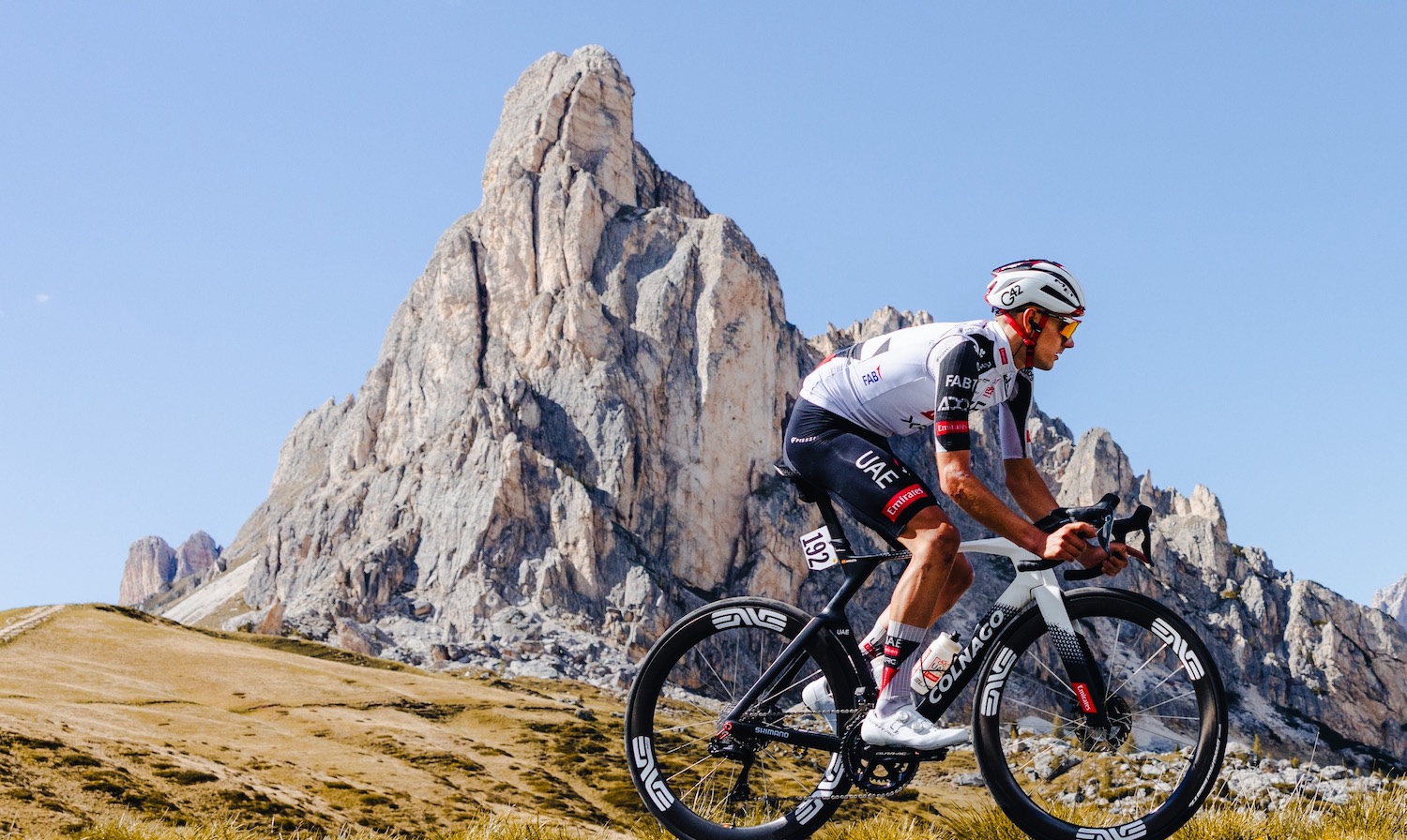
Passo Giau, Colnago at Giro d’Italia


