
Advanced packaging: strategy, value creation and competitive advantage for Italian companies
“The Italian code” is a blog on Made in Italy and symbol-intensive industries, coordinated by Gabriella Lojacono.

For most of its industrial history, packaging was treated as an ancillary cost: a protective layer specified at the end of the product development cycle and valued largely according to its production cost rather than its contribution to customer value and brand differentiation. That classification no longer describes what happens in symbol-intensive industries. In luxury, beauty, eyewear, jewelry, and wine and spirits, packaging has migrated from the periphery of the value chain toward its strategic core, and it now concentrates an unusual density of managerial problems. Brand identity, consumer experience, regulatory compliance, supply chain resilience and environmental accountability all converge on the same object.
The current conjuncture makes the case sharper. As luxury volumes slowed through 2024 and 2025, brands responded by raising the quality and personalization of every touchpoint rather than expanding assortments, and packaging is among the first places where that choice becomes visible. In parallel, the European regulatory agenda, most visibly the Packaging and Packaging Waste Regulation, is turning packaging into one of the most heavily governed artifacts in the consumer economy, with requirements on recyclability, traceability and documented impact along the entire chain. The supply side remains structurally fragmented: there is no dominant global leader, and a large number of specialists compete on niches, geographies or product types. Fragmentation of this kind typically precedes consolidation, and consolidation is precisely what is underway.
Italy occupies a distinctive position in this transition. Its industrial districts combine artisanal depth with engineering capacity, and decades of proximity to the great luxury houses have trained its suppliers to standards that few ecosystems can match. Within this landscape, Brandart offers an instructive case. Founded by Mr. Maurizio Sedgh twenty-five years ago in Busto Arsizio, in Lombardy, the group closed 2024 with revenues of approximately 230 million euros and a workforce of 470 people. Roughly two thirds of its business comes from fashion, with eyewear accounting for close to a quarter and the remainder distributed across jewelry and watches, beauty, technology and automotive. Geographically, Europe generates 58 percent of sales, Asia-Pacific 24 percent and the Americas 18 percent. After opening its capital to Tikehau Capital in 2023, which acquired a 25 percent minority stake, the company completed three acquisitions by 2025: Atelier Archiand, active in beauty, tech and travel retail; ABC Lab, specialized in boutique interiors and window displays; and Terotecna, an Apulian firm whose mechatronic and lighting expertise produces monumental scenographic installations for luxury retail environments worldwide.
Massimo Paloni joined Brandart as CEO in 2024 after twenty-two years at Bulgari, where he served, among other roles, as Chief Operating Officer and Vice President of Global Supply Chain. The conversation that follows uses the Brandart trajectory to examine a broader question: how an activity long classified as a cost becomes a locus of strategy, value creation and defendable advantage.
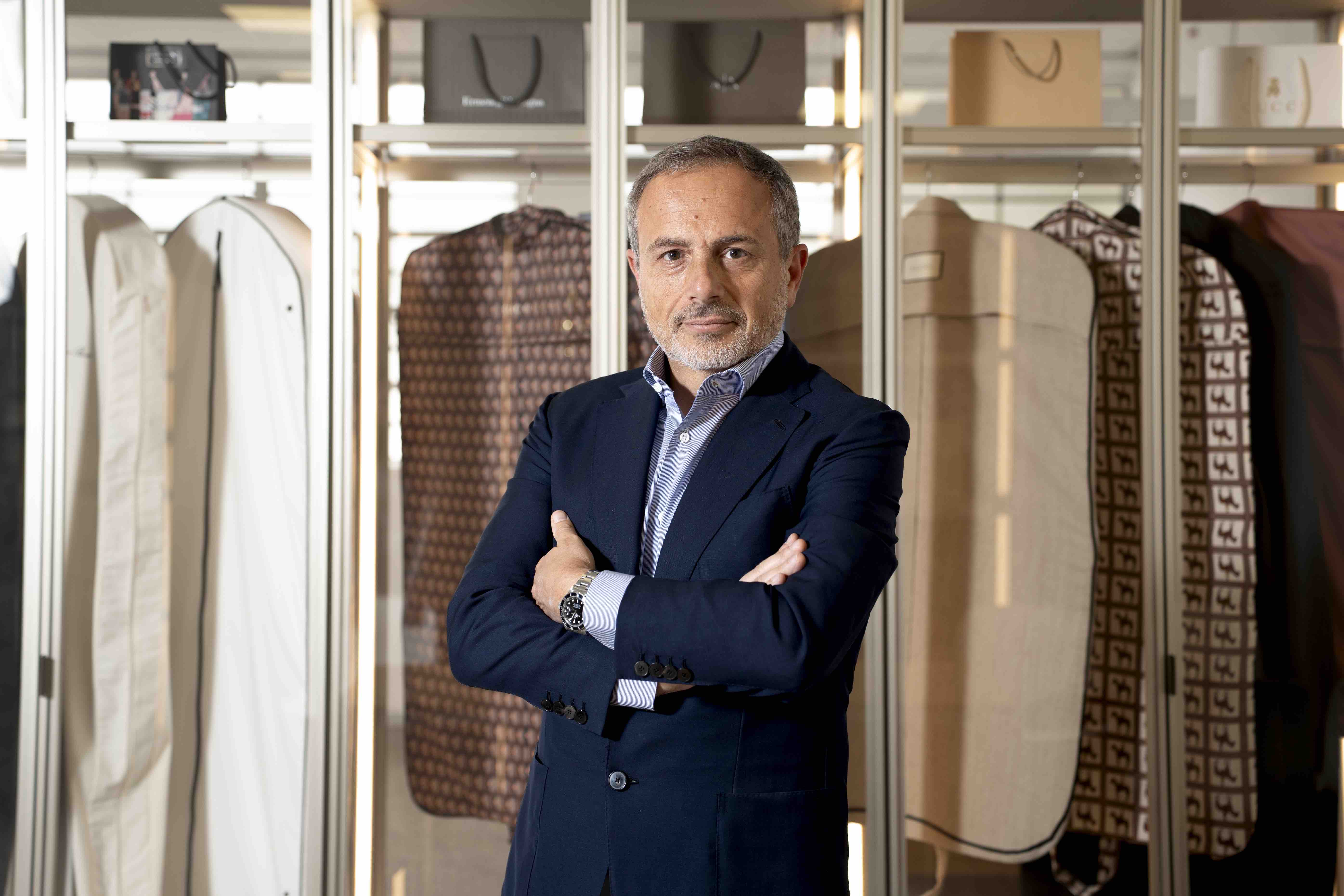
Massimo Paoloni, CEO, Brandart
Defining the object of analysis
GL : The term “advanced packaging” circulates widely in industry discourse, often with little definitional discipline. What does it actually denote today?
MP : A useful definition starts from what packaging is asked to do rather than from what it is made of. Take a single object, the box of a leather good or a fragrance that leaves an Italian workshop and reaches boutiques in more than a hundred countries. That box has to survive a global logistics chain without a mark, open in a way that stages the product and carries the identity of the maison, satisfy the recyclability and labeling requirements of the new European rules, behave responsibly once the client has unwrapped it, and now also carry a digital identity that lets us document where its materials come from and what their impact is. No single technology delivers all of that at once. What makes packaging advanced is the capability system behind it: the integration of design, engineering, materials research, regulatory expertise, traceability and logistics into one managed process. The same box that used to be specified at the end of the cycle and bought on price now concentrates brand, compliance and data in one artifact. I would add that the perimeter has widened. The discipline that governs that box, protect, signify, engineer, trace, recover, now extends to displays, windows and retail scenography, which are the brand's physical language expressed at a larger scale. Once you see packaging as the governance of that language across touchpoints, the adjective becomes clear.
Where value is created
GL : Along the value chain, where exactly does advanced packaging create value?
MP : At the interfaces, more than at any single stage. The first interface is the translation of creative intent into industrial feasibility: this is consultative work, done with the client’s design and marketing teams before anything is produced. The second is orchestration, meaning the coordination of a wide network of manufacturers, logistics providers and quality controls into a coherent outcome. The third, growing fastest, is the information layer: traceability, certified impact data, compliance documentation. We recently completed a structured listening exercise with our clients, and the architecture of their selection criteria was instructive. Quality, compliance and price operate as entry requirements; consultative competence and reliability determine who is actually chosen; innovation and contribution to the brand’s success define partnership. Value migrates from product attributes to relationship capabilities as the relation matures, and price behaves as a threshold rather than a differentiator.
The sectoral geography of the phenomenon
GL : In which industries has packaging become critical to margins and profitability, beyond its branding function?
MP : Wherever high unit margins meet high symbolic content. Fashion and leather goods, jewelry and watches, beauty, eyewear, wine and spirits, and increasingly consumer technology, which has absorbed luxury codes in its unboxing rituals. In these sectors the packaging is read as part of the product; an imperfect box reads as an imperfect object. The most interesting development is the continuity between packaging and the store itself. Windows, in-store displays and event scenography apply the same grammar at architectural scale, and brands increasingly want one partner able to guarantee coherence across all of it. That contiguity explains our entry into visual merchandising and retail installations.
Business models and the Italian advantage
GL : Which business models dominate the industry, and why does Italy hold such a strong position internationally?
MP : Three models coexist. Vertically integrated manufacturers, specialized by material or category; small ateliers competing on craftsmanship and extreme flexibility; and integrated platforms that orchestrate networks of producers while internalizing the most critical capabilities. Brandart belongs to the third family. As for Italy, I would resist the purely romantic reading. Provenance opens the door, but what clients ultimately buy is delivery capability. The real Italian asset is organizational: districts that concentrate generations of know-how, the ability to move from prototype to industrialization quickly, and a habit of working to luxury standards built through decades of proximity to the maisons. Terotecna is a good illustration: its lighting craft draws on an Apulian tradition active since the seventeenth century, now combined with robotics and mechatronics.
The Brandart trajectory
GL : How has Brandart built its current positioning? Was growth driven more by client relationships, acquisitions, innovation or capability building?
MP : The sequence matters. For two decades the company grew organically as a procurement and project management specialist for packaging, building deep client relationships and a qualified network of more than 150 manufacturing partners, coordinated from Italy with offices in Paris, New York and Guangzhou. That phase created the relational and operational base. The second phase was a deliberate acceleration: the entry of Tikehau Capital in 2023 gave us the structure to invest, and between 2024 and 2025 we completed three acquisitions that internalized design and production capabilities in visual merchandising and scenography. Each acquisition was selected for a competence the platform lacked, never for volume. So my answer is capability building, with acquisitions as the instrument and client relationships as the compass.
The sources of defensibility (or barriers to imitation)
GL : What makes the company difficult to replicate, and which indicators matter most in assessing competitive advantage in this industry?
MP : I see three layers. The first is industrial: the ability to guarantee the same standards, in quality, compliance and execution, across every geography in which a brand operates. The second is informational: traceability systems, certifications and audit infrastructure represent an important fixed cost, and that clients increasingly treat as a precondition. The third layer is relational, and it is the hardest to copy. Our clients describe a service culture in which a difficult brief is greeted as a project to start rather than a problem to manage, and that attitude, multiplied across hundreds of interactions, becomes reputation. On indicators: on-time delivery and quality remain the hygiene metrics, but we also measure perception formally, through structured surveys of clients, with explicit mapping of drivers of judgment. A premium price position survives only if those three layers justify it.
Demand-side evolution
GL : What do clients ask for today compared with ten years ago?
MP : Ten years ago the conversation was specification, price and delivery date. Today it covers certified ESG data, end-to-end traceability, co-design, speed of prototyping and, more and more, risk: duties, geopolitical instability, continuity of supply. The modern client buys risk reduction and knowledge alongside objects, and expects the supplier to act as a source of market intelligence, on regulation, on materials, on what is technically possible. There is also an organizational evolution on the demand side that I find significant. We deal with two distinct buyer profiles: strategic interlocutors, who evaluate coherence with brand identity and long-term innovation, and operational interlocutors, who evaluate execution, reliability and cost. The same supplier must serve both, with different languages and different evidence, and the firms that fail in this industry usually fail at one of the two.
Geographic adaptation
GL : Does advanced packaging require adaptation across geographic markets, or does globalization impose convergence?
MP : Both forces operate at once. North America rewards industrial scale; Europe is the terrain of creative experimentation and of the most demanding regulation; Asia-Pacific imposes speed and agility, with product cycles that compress every deadline. Sustainability expectations, retail systems and logistics infrastructures differ accordingly. The managerial problem is to hold global coherence of standards while adapting locally, because a luxury brand cannot accept that its packaging or its installations express different levels of quality in Milan, Dallas and Shanghai. Our answer combines centralized governance of standards with selective nearshoring, which also reduces exposure to duties and instability. On innovation, the map has changed: Asia drives pace, Europe drives compliance-led innovation, and the two increasingly feed each other.
A closing reflection
GL : If you had to identify one transformation that executives still underestimate in this industry, what would it be?
MP : They underestimate how much of their strategic agenda already sits inside packaging. Regulation, decarbonization, consumer experience, supply risk and brand storytelling intersect in this category, yet many organizations still govern it as a procurement line item, several levels below the decisions it affects. The second underestimation concerns sustainability. Read as compliance, it is a cost; treated as a platform capability, it changes products, price architecture and risk profile, and it builds barriers that competitors must climb. My suggestion to managers is simple: look at where information about your product is produced, certified and guaranteed. In our industry, that is increasingly where competitive advantage will be defended.
What advanced packaging teaches us
Value migrates to intermediate industries . In symbol-intensive sectors, competitive advantage increasingly resides in business-to-business suppliers whose capabilities are inseparable from the brands they serve. The invisible part of the chain is becoming the strategic part.
Integration is a business model . One-stop platforms compete by lowering coordination costs for clients and raising switching costs around themselves; the advantage compounds as each new capability connects with the others.
The Italian advantage is organizational . Districts, prototyping speed and decades of proximity to luxury clients matter more than provenance as a label. Craftsmanship defends its value when embedded in industrial discipline and international scale.
Sustainability is becoming infrastructure . Beyond compliance, certified traceability and impact data constitute a fixed-cost capability that concentrates the industry, sustains premium pricing and raises barriers to entry.
Relational capital can be managed . Service culture and structured client listening operate as managerial disciplines, with their own metrics, and rank among the assets most resistant to imitation.
Packaging is turning into an information business . As objects carry certified data on origin, impact and circularity, the center of gravity of the sector shifts from manufacturing artifacts to governing information.


