
Does a lot of negotiations mean real negotiation? The talks at risk after Iran

The attack by the United States and Israel on Iran is a dramatic indicator of the fragility of a global system in which the number of negotiations does not correspond to genuine negotiating activity. From a technical standpoint, we have witnessed an example of negotiation under deterrence, in which the accelerator of coercion was pushed to the point of reducing any room for negotiation to zero.
And, unfortunately, the Iranian case is not the only instance of talks in which we lack a negotiating architecture, understood as the structural design of negotiation processes.
Summits, international conferences, mediations, forums, diplomatic missions. The frequency with which these words appear in the media suggests that international negotiation is more alive than ever. And indeed, when analyzing the international landscape starting in 2020, the global system has not stopped negotiating for a moment. Yet, from a technical negotiation perspective, not all interactions presented as “negotiations” qualify as such in the strict sense: some are representations of (actual or ideal) strategic positioning, others are primarily symbolic in nature, and still others are isolated attempts that fail to affect the overall structure of relations between the parties.
For many reasons, 2020 represents the beginning of a new phase of global and systemic instability. The effects of the pandemic are numerous and widely discussed in the literature on systemic risk. Among them are heightened technological rivalries, the intensification of certain domestic polarizations, the exposure of institutional fragilities, and the redefinition of global power balances. It was therefore a significant shock, not merely temporary, and it is proving to be a breaking point for many frameworks and equilibria, triggering a structural reconfiguration of social and economic interdependencies.
The central question is how negotiations are being conducted. In other words, are all these negotiations relying on robust processes and structures? A deeper analysis reveals that many interactions are presented as negotiations but are not managed as such. A negotiation, in fact, presupposes the presence of certain constitutive elements:
- The recognition of mutual interdependence.
- The possibility of exchanging resources (simultaneously or at different times).
- The analysis of alternatives.
- The construction, even gradually, of shared decisions.
So, are negotiations being conducted properly? To answer this, let us recall some of the significant negotiation dossiers of the past six years and analyze them through a technical lens to understand whether recurring patterns exist and how the way of negotiating is changing.
United States-Iran: negotiation under deterrence. In recent months (late 2025-early 2026), indirect talks between the United States and Iran on the nuclear dossier had resumed, with mediation by Oman and monitoring by the International Atomic Energy Agency. At the same time, military pressure had intensified. Negotiation unfolded in a context of active deterrence, known in the literature as coercive diplomacy, where direct dialogue is replaced by alternating phases of pressure and openness. The more deterrence increases, the more negotiation space shrinks; this, in turn, reduces the motivation to reach a compromise. This downward spiral reached its most extreme consequences over the past weekend.
Russia-Ukraine: negotiation by silos. Within the context of the high-intensity war between Russia and Ukraine, limited negotiation spaces have nonetheless opened, leading to certain agreements: humanitarian corridors, prisoner exchanges, and the Black Sea Grain Initiative (supported by the United Nations and Turkey in 2022-2023). However, these agreements have not altered the overall structure of the conflict, which remains centered on territory, security, and strategic identity. Negotiation exists, but when managed in “silos” and without placing core priorities at the center, it may yield results, even significant ones, but only temporarily.
United States-China: negotiation over escalation and systemic risk management. The relationship between the United States and China has a dual dimension: economic interdependence and strategic competition. Tensions that have intensified over semiconductors and, more broadly, Taiwan’s independence, have become intertwined with discussions on global financial stability and climate. Negotiation thus becomes escalation management rather than a mechanism for jointly building trust and value. In other words, it has turned into a series of interactions defining the rules for continuing to compete without triggering systemic ruptures.
Climate diplomacy: multilateral negotiation. The COPs from 2021 to 2025 (Glasgow, Sharm el-Sheikh, Dubai, Baku, and Belém), while displaying different negotiation configurations, are based on the recognition of systemic interdependence (in this case, global climate risk) as the source of space for multilateral integrative negotiation. Although tensions remain, for example over financing and historical responsibilities, and outcomes are fragile, the negotiation structure is clearly identifiable: stakeholder inclusion, iteration among parties, and review mechanisms.
Post-2022 energy alliances: structured negotiation. After 2022, many countries redefined their energy interdependencies, diversifying supplies and evaluating new alliances. These negotiation dynamics may be less visible in the media (there is far less theatricality compared to other situations), but are highly structured, with necessity imposing coordination and the adoption of a linear and formal process.
Mediations on Gaza: structural fragility. Between 2025 and early 2026, attempts at ceasefires and humanitarian exchanges continued through the intervention of third-party mediators. From a technical standpoint, this case shows that certain agreements, even if temporary, are possible in highly fragmented contexts. However, here too, acting in silos without an inclusive negotiation architecture and a shared negotiation perimeter reduces the effectiveness of efforts and, consequently, the sustainability of agreements.
BRICS+: continuous structural (re)negotiation. The expansion and consolidation of the BRICS+ group in the 2024-2026 period represents the construction of a multilateral institutional arena alternative to traditional ones, such as the G7 or the WTO. Here, negotiation concerns economic architecture, financial coordination, and the redefinition of global balances. Although interactions may be less overtly conflictual, the presence of divergent interests requires continuous revision of the existing structure. It is precisely this ongoing review process that ensures the stability of this institutional configuration.
Artificial intelligence governance: preventive negotiation. Between 2025 and 2026, multilateral negotiations (European Union, United States, and other actors) continued on AI regulation and the definition of possible reference standards. From a negotiation standpoint, the attempt is to build a preventive architecture before technological escalation occurs. In other words, negotiation is oriented toward defining common principles in a competitive context.
Two analytical lenses
The dynamics described above, when analyzed individually, may appear heterogeneous. However, read systemically, common recurrences, or patterns, emerge across the cases. To better highlight these patterns, two analytical lenses can be used.
The first lens concerns the continuum between distributive and integrative negotiation.
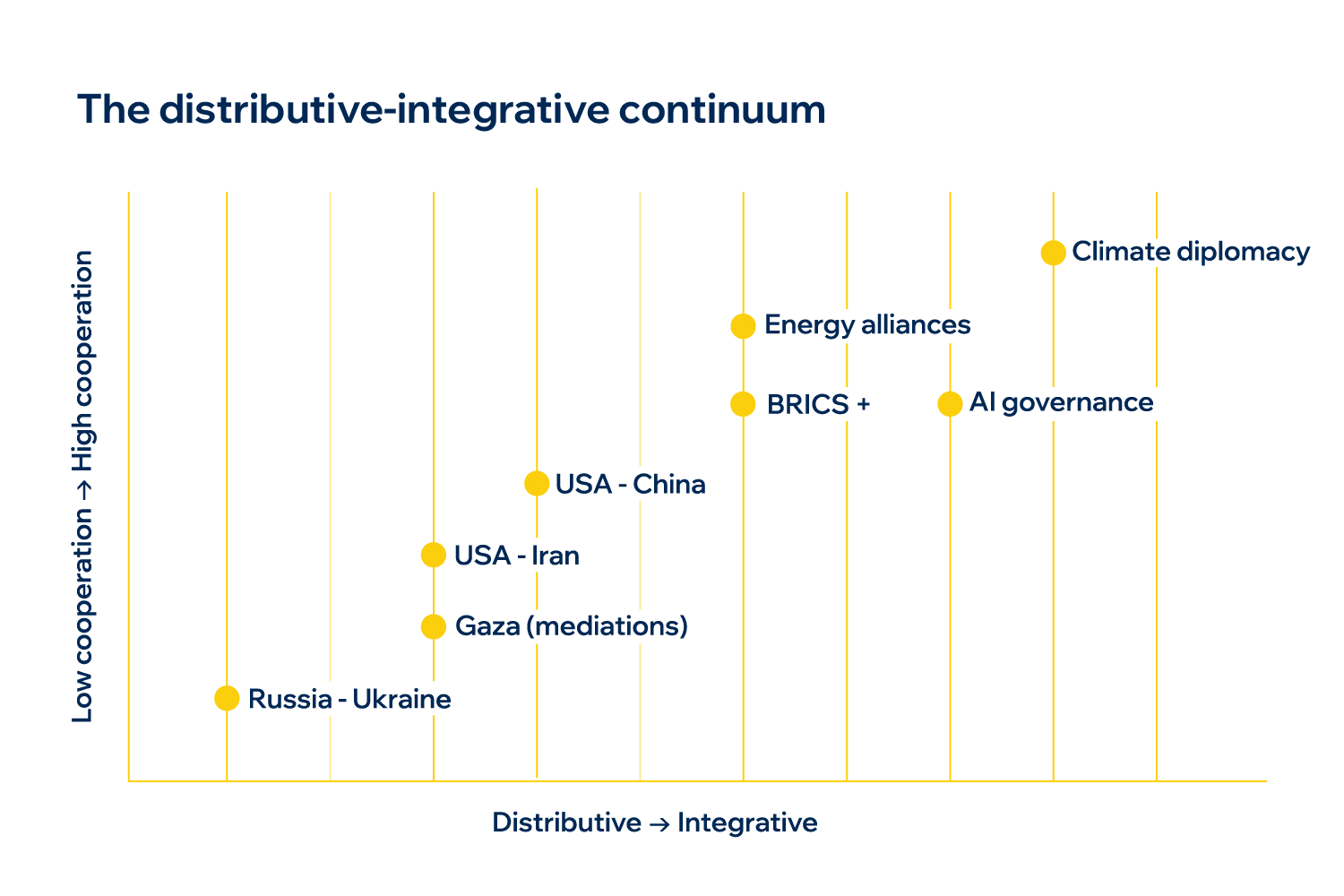
During the period under review, there is a strong concentration of cases in the distributive or hybrid quadrant. Fully integrative configurations are limited and, in any case, predominantly multilateral. This suggests a systemic shift toward negotiations aimed at managing competition rather than jointly creating value. Integrative negotiations become selective and confined to contexts in which interdependence is explicitly recognized.
The second lens distinguishes between negotiation under deterrence and symbolic negotiation.
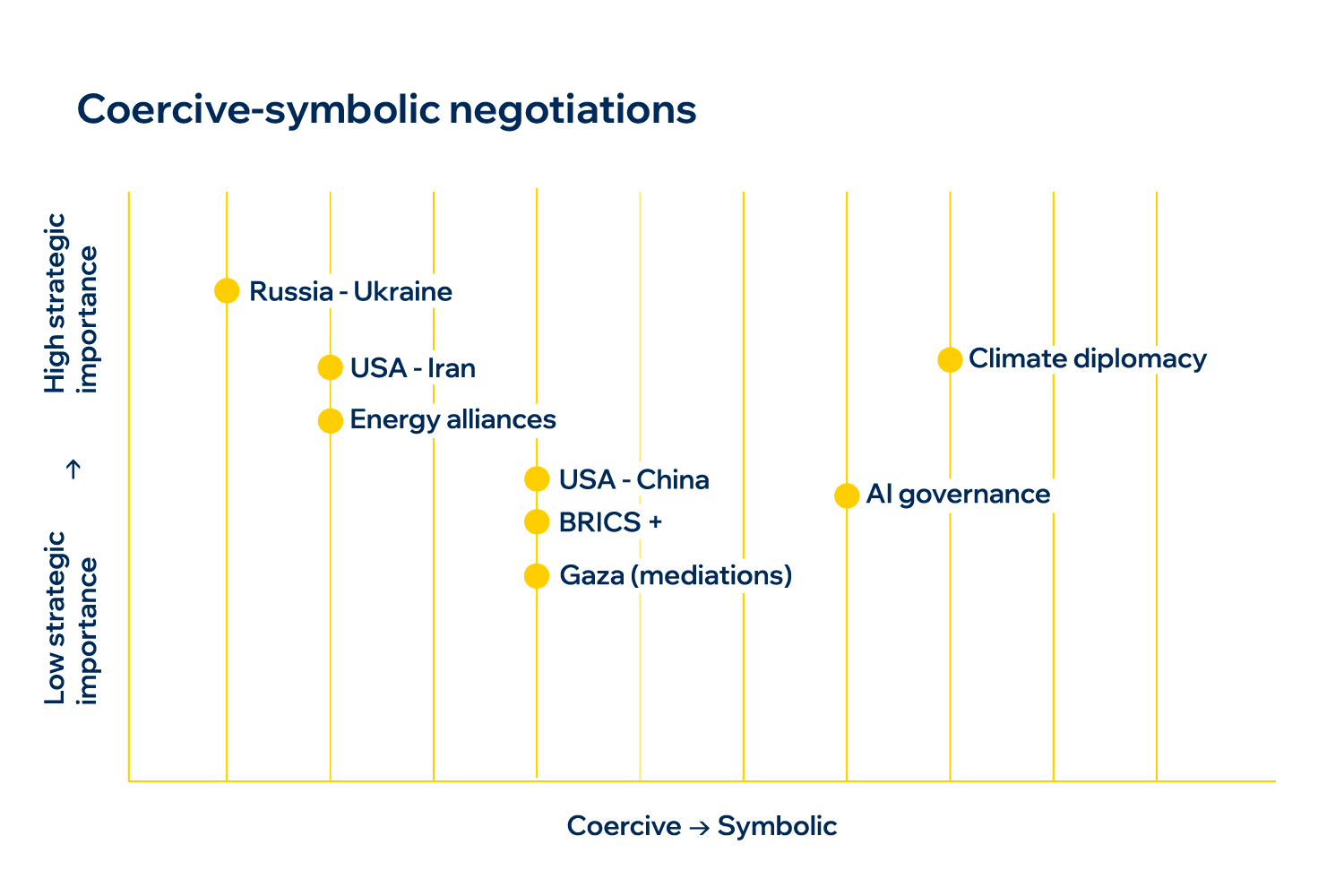
Case analysis highlights growing polarization between interactions characterized by deterrence and those marked by high symbolic visibility. The former, while maintaining strategic relevance, reduce space for collaboration, whereas the latter increase visibility but often lack an implementation structure. This configuration makes it more complex to design stable negotiation processes.
The main patterns
The proposed map does not serve a classificatory function but aims to highlight several structural patterns, specifically five, presented below:
- Negotiation in the shop window. Negotiation takes place under constant public scrutiny. As a result, media visibility reduces the scope for exchange and compels communicative performances that often constrain the ability to reach agreement. It is therefore important to manage external communication separately from internal negotiation mechanisms.
- Negotiation under deterrence. Deterrence and dialogue coexist in hybrid configurations. Deterrence is used as a tool to push for openness but, especially if excessive, reduces space for lasting agreements. It becomes crucial to define the agenda and sequencing of issues, avoid undue pressure, and establish a system of incentives and guarantees for implementation.
- Negotiation by silos. Many agreements are technical and confined to specific issues (a silo approach) and thus tend to resolve immediate matters without restructuring overall interdependence. This creates fragility over time. It is necessary to maintain a comprehensive vision and establish a negotiation structure capable of addressing the long term as well.
- Negotiation with low real impact. The gap between high-narrative-performance interactions (summits, media showcases) and results with concrete impact is widening. There is a need to translate performance into concrete mechanisms for implementation and monitoring.
- Negotiation as a stability variable. The effectiveness and durability of agreements depend on the ability to design an architecture that includes relevant stakeholders, logical sequencing, monitoring mechanisms, and incentives for implementation. Without such architecture, even technically sound agreements remain fragile.
In a global system characterized by high interdependence and, at the same time, widespread vulnerability, it is not the quantity of negotiations that determines stability, but the quality of the architecture that supports them.


