

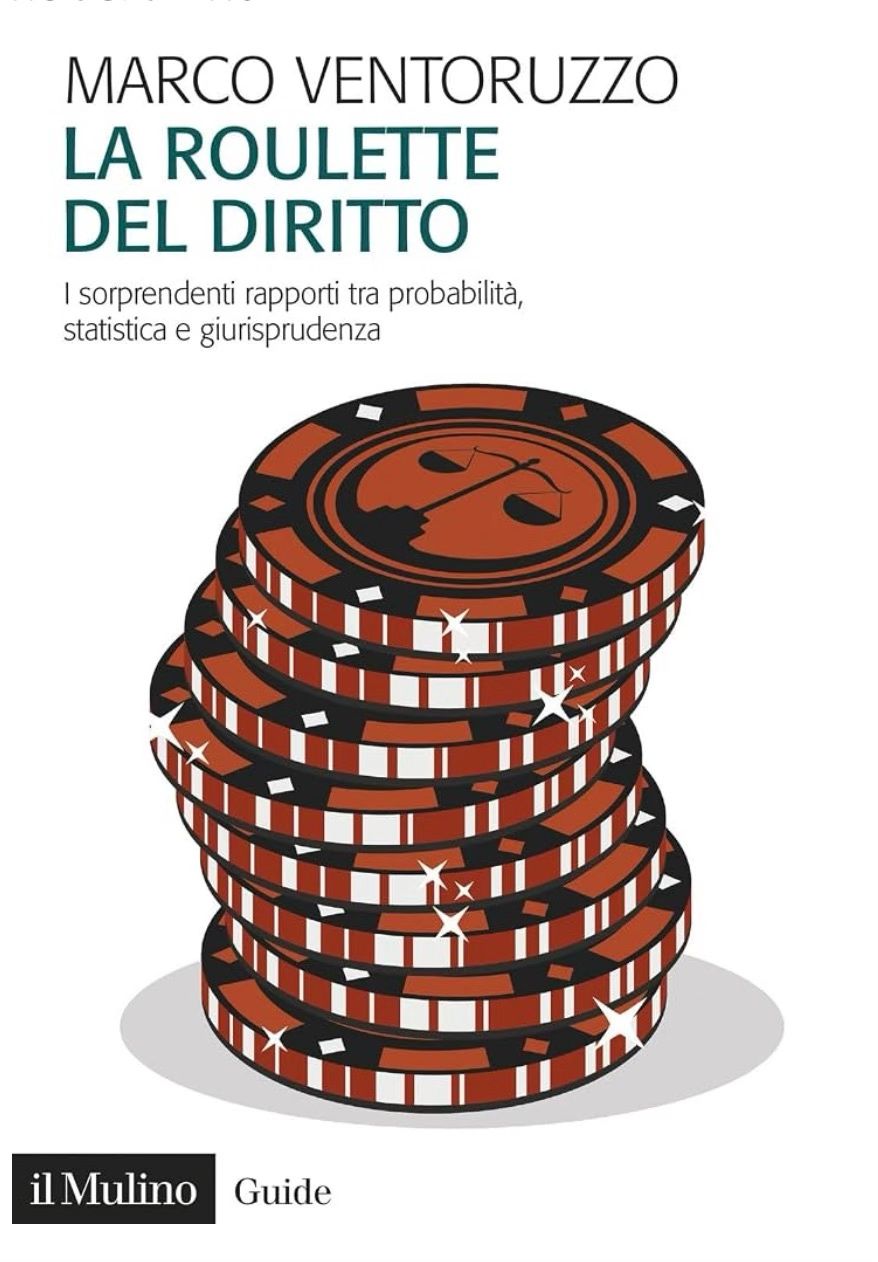
Writing good laws and evaluating evidence also means being able to interpret numbers. This is the conviction at the heart of La roulette del diritto. I sorprendenti rapporti tra probabilità, statistica e giurisprudenza [The Roulette of Law: The Surprising Connections between Probability, Statistics, and Jurisprudence], by Marco Ventoruzzo, published by il Mulino (available only in Italian).
The people who write, interpret, and apply the rules governing our society must be open to looking beyond the law, drawing on the knowledge and methods that other disciplines apply to study reality and explore how it might evolve. This dialogue requires reciprocity: experts from other fields who wish to contribute to shaping the rules must understand legal reasoning and know how to engage with legal scholars and practitioners. Excessive specialization narrows perspectives, limits the understanding of problems, and diminishes the effectiveness of solutions.
 Ventoruzzo does more than argue for the benefits of eclecticism. In recent years, he has created comic strips explaining the history of law and launched a column called “Law and…” in the Rivista delle società with the first article on logician Kurt Gödel. He’s also written a book on art and law and developed a series of infographics on comparative corporate law on ECGI.
His new book is divided into three chapters, each examining the intersection of law and quantitative reasoning from a different perspective. Ventoruzzo begins with private parties entering into contracts and allocating risks, from betting to financial derivatives. He then adopts the perspective of lawmakers grappling with the effects of legislation, relationships between phenomena, and potential errors in reasoning. Finally, he moves into the courtroom, where evidence, probability, and artificial intelligence contribute to the debate over how facts should be established.
An appendix on choosing which law firm to work for provides readers with an opportunity to explore decision-making when alternatives open up one at a time.
Ventoruzzo warns that because of the persuasive power of numbers, it essential to scrutinize how they are used. In a California court case he recounts in the book, the mistaken assumption that certain personal characteristics were independent of one another contributed to a conviction that was later overturned. The apparent precision of the result had concealed the weakness of the reasoning. This risk extends far beyond the courtroom: Two phenomena may move together without one causing the other, an average number may hide crucial differences, and a model may appear convincing simply because its underlying assumptions have been forgotten. Hence the invitation to revise one's beliefs when new information becomes available, as Bayes' theorem requires. Changing one's mind in light of experience is a responsibility of all decision-makers.
The book may therefore appeal to lawyers, lawmakers, and law students, but also to managers dealing with forecasts, expert advice, contracts, and risk assessments. It helps readers ask experts more precise questions and recognize when a result should be taken with a grain of salt.
Ventoruzzo guides readers through stories, cases, and paradoxes, introducing formulas and calculations whenever they help clarify the problem at hand. The result is an accessible read even for people with a humanities background or whose work lies far from legal and financial functions, with the added benefit that readers will learn how to exercise independent judgment when a decision is presented as inevitable simply because it is backed by numbers.
Publisher: il Mulino.
Publication date: 2026.
Pages: 208.
ISBN/EAN: 9788815397683.
Format: Carta, E-book.


