
Moving from fear to desire, sustainability can still be sold

Sustainability, on its own, does not sell, but the marketing arsenal includes several tools capable of turning the situation around, argues Walter Susini in his book Green Don't Sell. Why sustainability alone fails: the real rules of green marketing (EGEA, 2026).
According to the author, the greatest limitation of environmental strategies over recent decades has been their reliance on fear, guilt, and the prospect of future sacrifices. To truly change behavior, however, it is necessary to adopt the tools that marketing has always used successfully: communicating tangible benefits, offering immediate rewards, creating aspiration, and fostering emotional engagement. Sustainability must stop being perceived as a form of deprivation and become a desirable proposition, one capable of speaking to people before it speaks to citizens or activists.
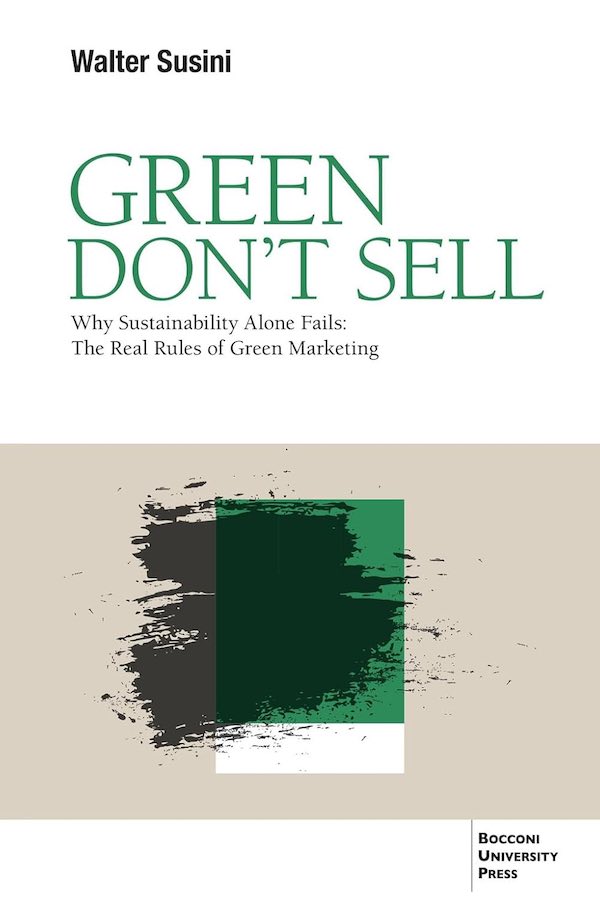 “It is called Green Don't Sell ,” the author wrote on LinkedIn , “and yes, the grammar is wrong on purpose. If sustainability wants to talk to real people, it can start by sounding like one.”
The book begins with the recognition of a crisis: sustainability, Susini argues, has become less attractive and less influential in public debate. After analyzing the shortcomings of the current environmental narrative and the difficulties involved in changing established behaviors, the author examines the role of the various stakeholders involved (companies, consumers, governments, and civil society organizations) before introducing the idea of a new sustainability marketing. The central chapters draw on behavioral psychology, neuroscience, and management practices, while the final chapters present an operational framework and a practical guide for those seeking to turn sustainability into a driver of change.
One of the book’s most interesting aspects is its attempt to overturn the traditional “apocalyptic” communication surrounding environmental issues. Susini observes that messages built exclusively around warnings and prohibitions risk generating paralysis, resignation, or even rejection. Hence the proposal to move from storytelling to “storydoing” and, beyond that, to “storybounting,” a neologism he uses to describe a narrative based on abundance, generosity, collaboration, and shared success.
Communication about sustainability must show people how they can be part of the solution while obtaining tangible and immediately perceptible benefits.
The book and the newsletter on the same topics, which the author distributes through Substack , are useful for managers, communication professionals, ESG executives, and entrepreneurs facing the challenge of making their sustainability initiatives both credible and effective. But the book is also of interest to those working far from marketing: chief financial officers, operations managers, and HR executives will find a practical reflection on how to build consensus around change.
Publisher : EGEA
Publication date : 2026
Pages : 176
ISBN/EAN : 9791222930688
Format : Print, ePub
WALTER SUSINI is a Professor of Practice at SDA Bocconi School of Management. His interest in corporate purpose and sustainability has deep roots: in 2007, he founded a strategic consulting firm with offices in Mexico, Brazil, and Argentina, based on the conviction that brands and companies grow more successfully when they have a clear purpose at their core. He later worked at Unilever alongside Paul Polman on the Sustainable Living Plan, one of the most influential corporate sustainability programs of the past decades. He serves on the boards of three companies, where he sits on governance and sustainability committees. From 2017 to 2023, he was Senior Vice President of Marketing for Europe and EMEA at The Coca-Cola Company.


