
Ignoring nature, cynics leave a bill we will all have to pay

There can be no lasting economic prosperity without respect for nature, argues Sylvie Goulard in her book Green or Greed (Bocconi University Press, 2026)
The title refers to the cynicism of those who continue to ignore well-established scientific evidence, postponing decisions that become more costly every year. Biodiversity loss and climate change directly affect economic security, public health, water and food availability, and national competitiveness, yet cynics dismiss them as ideology. According to the author, waiting only increases the bill that citizens, businesses, and institutions will have to pay in the future.
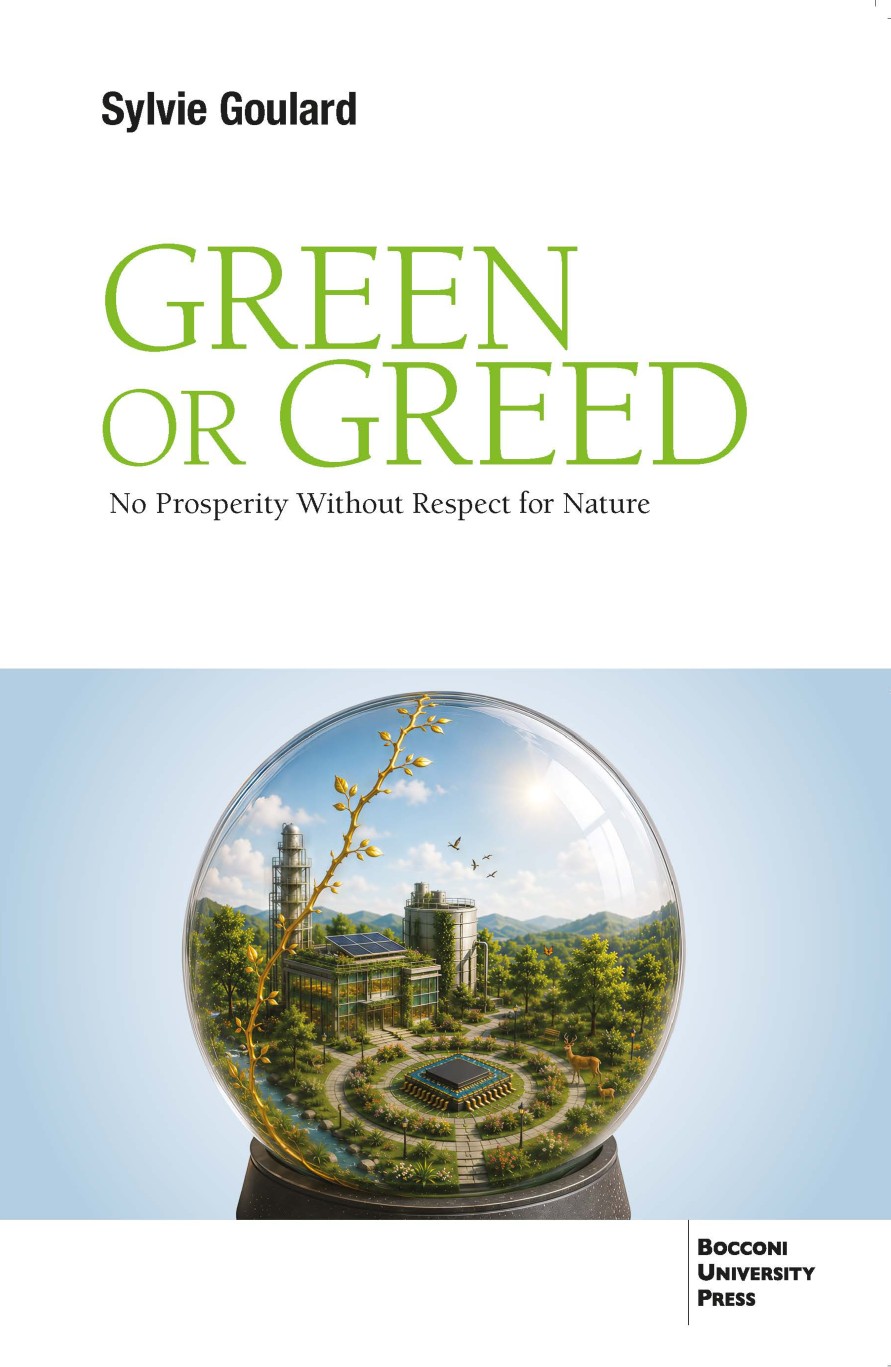 The book unfolds as a journey that begins with a critique of environmental denialism and moves toward possible solutions. After the introduction, Goulard urges readers to “face reality,” dismantling the arguments of those who downplay the ecological crisis. She then addresses the issue of political polarization, arguing that environmental protection should belong neither to the right nor to the left. The central chapters focus on the economic value of natural capital and the role of public institutions, while the final sections examine corporate responsibilities and the engagement of citizen-consumers.
The common thread running through the book is the idea that the transition requires coordinated action by all actors in society.
The book is also critical of an overly narrow view of competitiveness. Goulard argues that Europe risks compromising its future if it continues to regard ecosystem protection as a constraint rather than a prerequisite for development. Biodiversity is described as an indispensable form of capital, on par with financial or technological capital.
Particularly striking is the parallel between dependence on fossil fuels and humanity’s deeper dependence on nature. In both cases, the dependence is largely invisible, yet essential to the functioning of the economy. The author also calls for moving beyond the sterile conflict between growth and sustainability, arguing that innovation, competitiveness, and the ecological transition can reinforce one another.
The volume is valuable for citizens seeking to understand why environmental issues are no longer a niche concern. Business professionals will find a perspective that connects sustainability, risk, and strategy; policymakers will encounter arguments in favor of a long-term vision; and those who analyze the economy from other perspectives will discover how natural capital has become a decisive factor for growth. Using accessible language and drawing on numerous data sources, studies, and real-world examples, Goulard argues that true pragmatism today lies in recognizing that the economy operates within physical and ecological limits that cannot be circumvented indefinitely.
- Publisher: Bocconi University Press
- Publication date: 2026
- Pages: 104
- ISBN/EAN: 9791280623959
- Format: Print, ePub
SYLVIE GOULARD is co-chair of the International Advisory Panel on Biodiversity Credits (IAPB), an independent global initiative established by France and the United Kingdom to promote the creation of financial instruments aimed at protecting nature. A former deputy governor of the Banque de France, where she worked on green finance, she also served as France’s Minister of Defense and as a Member of the European Parliament. She is currently Vice President of the Institute for European Policymaking (IEP) at Bocconi University and Professor of Practice at SDA Bocconi School of Management.


