
AI is changing our ability to negotiate: How Augmented Negotiation works

Artificial Intelligence is entering complex negotiation processes at an increasingly rapid pace. AI can analyze large amounts of data and information, support preparation, devise alternative scenarios, simulate counterparts and, in some cases, actually play the role of one of the parties.
The growing adoption of AI raises a particularly important question: How does our ability to negotiate change when AI becomes an integral part of the process? To find an answer, we need to conduct a systemic analysis that considers how technology, experience, and human judgment can be organized within the same architecture. We can define this configuration as Augmented Negotiation : a human-centered approach in which AI hones the negotiator’s ability to understand the context, prepare, simulate, interact, observe, reflect and adapt, and all this while agency, judgment, and responsibility remain with the negotiator.
From automation to augmentation
Automation and augmentation are different phenomena. In very simple terms:
- Automation transfers to technology a task previously performed by a human being.
- Augmentation uses technology to enhance the capabilities with which a person performs that task.
In the first case, the primary value lies in efficiency and the ability to carry out a task; in the second, value also concerns the quality of the judgment, experience, and learning generated by doing so.
This distinction is also relevant to negotiation which, in fact, requires a combination of analysis and interpretation. Interests, alternatives, and possible agreements coexist with trust, power, reputation, culture, relationships, and emotions. The information available is often incomplete; some may be deliberately withheld, while some can take on different meanings depending on who reads and interprets it.
A concession, for example, can be seen as a signal of openness to collaboration or as a sign of weakness. An economically advantageous proposal can trigger a negative reaction when it is perceived as unfair or incompatible with the existing relationship between the parties. Negotiation capability therefore encompasses information processing, the ability to read the context, and judgment.
And it is precisely in this space that augmentation creates value. Technology increases the amount of information, experience, and perspectives available to the negotiator and creates additional opportunities to observe how that person makes decisions, to then develop their negotiation capability.
From AI as a tool to AI as an architecture
The adoption of AI in negotiation processes usually follows two configurations. The first views AI as a tool available to the negotiator: It analyzes documents, summarizes information, contributes to preparation, and generates possible scenarios. The second sees AI as a counterpart to the negotiation: The negotiator interacts with an artificial agent that plays the other party and reacts to the negotiator’s decisions.
However, there is a third configuration that further expands the scope: AI can be organized around the negotiator as an architecture consisting of specialized functions that intervene at different moments and share information and results.
Consider the different stages of the negotiation process. We need to understand the context, the parties, and their interests; prepare a strategy; explore alternative scenarios; test the interaction; observe behaviors and consequences; reflect on what has happened; and finally, adapt our approach. This sequence can be represented as a cycle: Understand, Prepare, Simulate, Engage, Observe, Reflect, and Adapt.
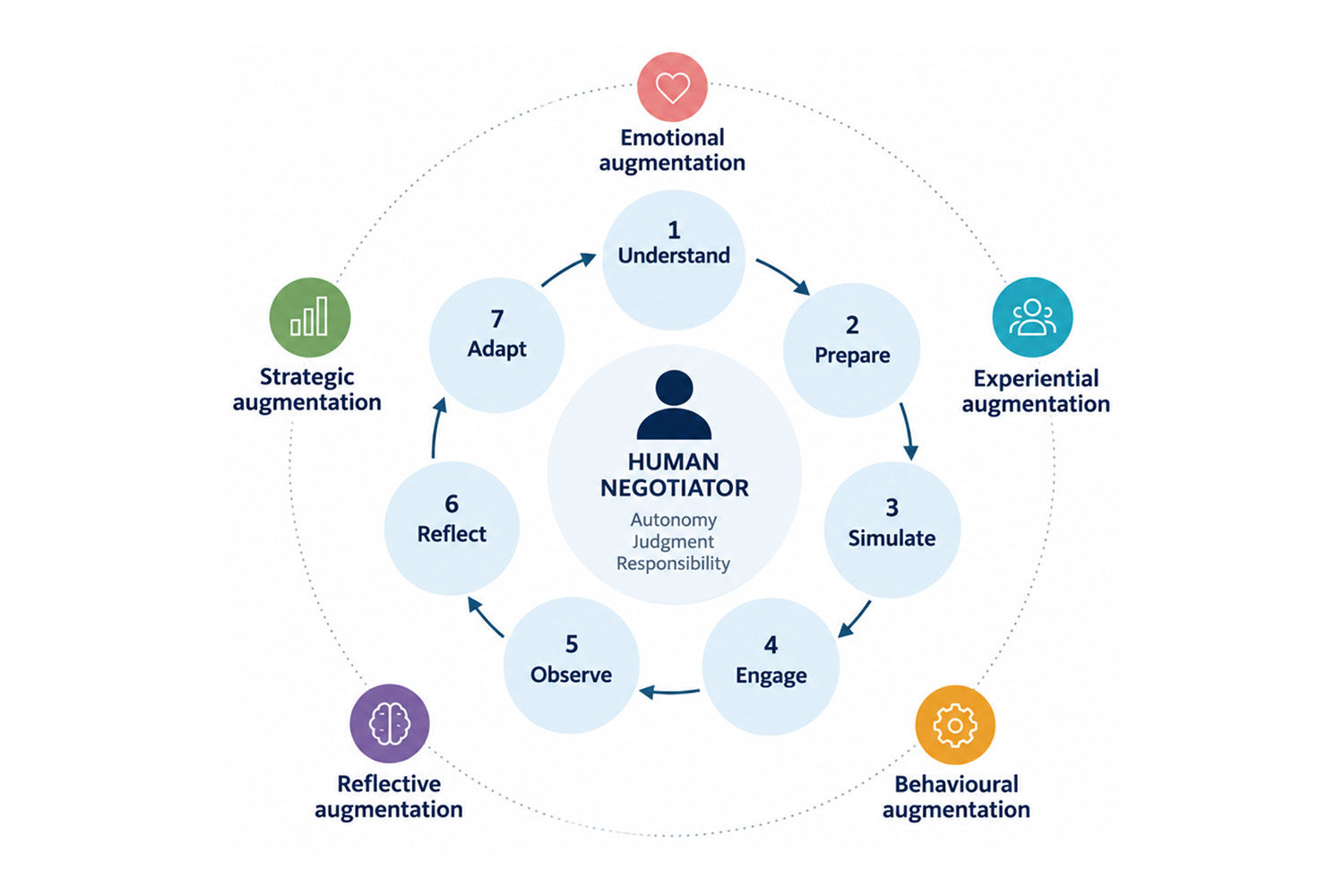
The Augmented Negotiation Cycle. The model represents an iterative process in which AI enhances the negotiator’s capabilities while the negotiator retains agency, judgment, and responsibility.
The five dimensions of Augmented Negotiation
Analyzing the process from this perspective reveals five dimensions in which AI can contribute to the development of negotiation capability:
- Strategic augmentation . AI improves preparation by providing information about the other party, interests, alternatives, previous behaviors, relationships among stakeholders, and possible scenarios.
- Experiential augmentation . AI multiplies opportunities for practice, making it possible to repeat a negotiation scenario, to vary certain conditions, and to simulate interactions with counterparts who have different negotiation approaches.
- Behavioral augmentation . AI adds an observational perspective on possible questions, concessions, reactions, decision sequences, signals, and shifts in strategy.
- Reflective augmentation . AI transforms experience and feedback into a structured process of interpretation, comparison, and adaptation over time.
- Emotional augmentation . AI increases awareness of the emotional dimension and can support processes of regulation, reappraisal, and management of reactions during interactions with the other party.
In the Augmented Negotiation Cycle, the most critical transition is from Adapt to Understand. The experience gained from one negotiation informs the understanding and preparation for the next. The central element is therefore the integration of the five dimensions throughout the same cycle and their contribution to the continuous development of negotiation capability.
Emotions and Human-AI interaction
The emotional dimension, a crucial aspect of every negotiation, is among the least intuitive when we introduce an AI counterpart.
In a recent experimental study, we compared Human-Human and Human-AI negotiations, analyzing factors such as positive affect, negative affect, emotion regulation, and subjective value, among others. The first point that clearly emerges is that emotions continue to play a significant role even when the counterpart is an AI agent. In the Human-AI condition, moreover, negative emotions appear to have slightly less influence on the evaluation of the experience, while the importance of emotional regulation increases. These differences suggest that interacting with AI may alter some of the mechanisms through which emotions shape the negotiation experience.
One possible interpretation of this observation concerns social-evaluative threat. Interaction with another person involves judgment, reputation, rejection, and interpersonal comparison. The presence of an AI counterpart may, under certain conditions, reduce some of the pressure associated with social evaluation and alter the processes of cognitive reappraisal and emotional regulation.
The emotional architecture therefore appears to change primarily in the relationship between social pressure, negative emotions, and the ability to regulate them. This is an interesting dynamic that certainly warrants further investigation to understand how the negotiation experience changes when the counterpart is an AI agent.
From one agent to an ecosystem
AI is, of course, also present in management education on negotiation at SDA Bocconi. For example, LEON – Leading Excellence On Negotiation – was “born” in 2024 and first tested in a course in October 2024, initially as a simple AI-based teaching assistant. It was subsequently developed into an AI-based negotiation coach, with the ability to support preparation, observation, analysis, and the delivery of personalized feedback for learning purposes.
In a second phase of the experiment in 2025–2026, participants completed an initial negotiation, received a structured analysis of the interaction, reflected on the feedback, and then conducted a second negotiation. The feedback was used as a tool for reflection and development, while comparing the two interactions made it possible to observe how negotiation behaviors evolved.
The next step involves the transition from a single agent to an ecosystem. In 2027, LEON will be configured as a system of specialized and interdependent AI agents. A Profiler will help users understand the parties at the negotiating table; the Simulation Lab will make it possible to explore different scenarios; the Sparring Partner and the Tough Negotiator will allow users to practice at different levels of complexity; the Negotiation Observer will analyze the interaction; and the Learning Journal will organize feedback and reflections over time.
The value of the ecosystem derives primarily from interdependence . In fact, the information generated at one stage can become input for subsequent stages. For example, a party’s profile can contribute to building a simulation, then what happens in the simulation can be analyzed by the Observer, and the feedback can feed into the Learning Journal and become part of subsequent preparation.
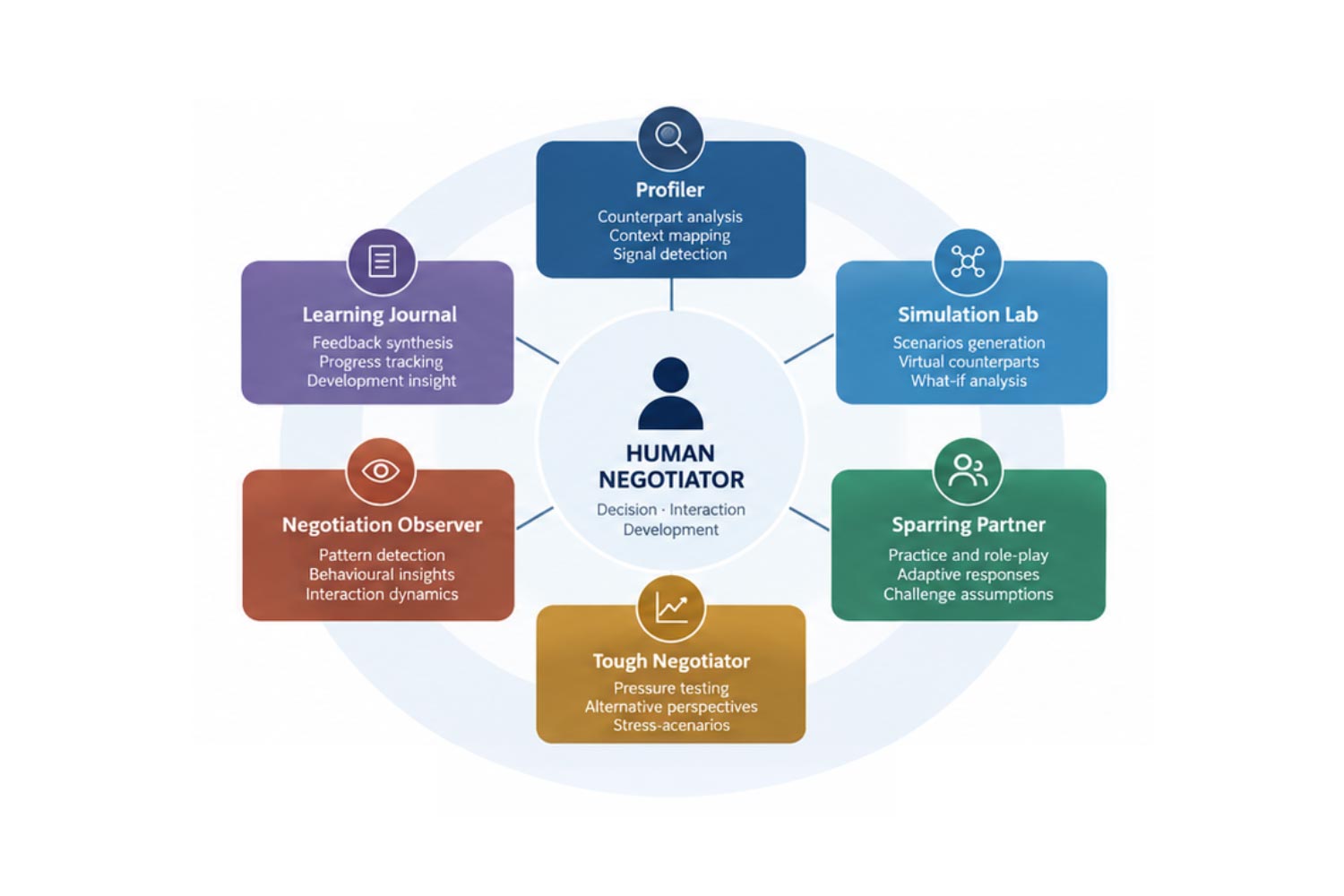
The LEON Multi-Agent Ecosystem. The ecosystem integrates specialized AI agents that support profiling, simulation, practice, observation, and reflection throughout the negotiation process.
Agency and the quality of the architecture
The value of Augmented Negotiation depends directly on the quality of the architecture that supports it. Quality, in turn, is anchored in a number of structural elements, including data accuracy, the theoretical robustness of feedback, the protection of sensitive information, interpretive capabilities, and the ability to critically examine recommendations.
Within this architecture, human agency is the fundamental principle. Negotiators retain responsibility for decisions, interpret the guidance they receive, compare it with other sources, and decide which information to incorporate into their approach. AI expands the range of available alternatives and observations, while human judgment gives them meaning in the specific situation.
An AI assistant supports the performance of a task; over time, AI augmentation cultivates the human capabilities that underpin that task. Information, experience, and feedback create value when they are transformed into understanding, reflection, and adaptation. Ultimately, the quality of Augmented Negotiation is measured by its ability to transform technology, experience, and feedback into a greater human capacity to understand, decide and negotiate.
The topics covered in this article are addressed in the program: Negoziazione e influenza. Imparare a gestire le relazioni professionali con efficacia e soddisfazione (in Italian).


