
A company is socially sustainable when technology and people evolve together

With the introduction of artificial intelligence into the workplace, companies must manage technological innovation and social sustainability at the same time, moving beyond fragmented approaches and organizational silos. This means putting people at the center of transformation processes and, above all, shifting from reporting on initiatives to measuring outcomes and the value actually generated over time. Digital technology is the means; sustainability is the goal.
The 2026 edition of the Social Sustainability Monitor by SDA Bocconi School of Management, conducted in partnership with SD Worx and with the contribution of Harvard Business Review Italia, portrays companies working on both fronts but still struggling with two challenges: integrating people-focused policies with technological investments, and measuring the changes that result.
Artificial intelligence as a litmus test
The research examines the intersection of digitalization and internal social sustainability, understood as a company's ability to protect and empower its people over time. Previous research had already established why these two dimensions should be considered together. Technologies can be purchased and replicated by competitors, but the way an organization combines them with skills, trust, and the ability to collaborate is much harder to imitate. Studies of sociotechnical systems also show that the benefits of innovation depend in part on the ability to rethink the roles, relationships, and autonomy of the people who use it.
Artificial intelligence makes this interdependence even more apparent. So how are companies responding? Does digital maturity go hand in hand with a comparable ability to develop and empower people? And what tools can help identify imbalances between these two paths?
Social sustainability and digitalization
The third edition of the study led to the development of a Social & Digital Matrix, which maps the level of internal social sustainability against the degree of digitalization.
An analysis of leading international frameworks, regulatory standards, rating systems, and rankings identified the 15 most relevant and material indicators for each dimension. The resulting matrix distinguishes four configurations: companies with limited development in both areas, companies more advanced in their people-focused policies, companies with greater technological maturity, and companies that combine high levels of both dimensions. 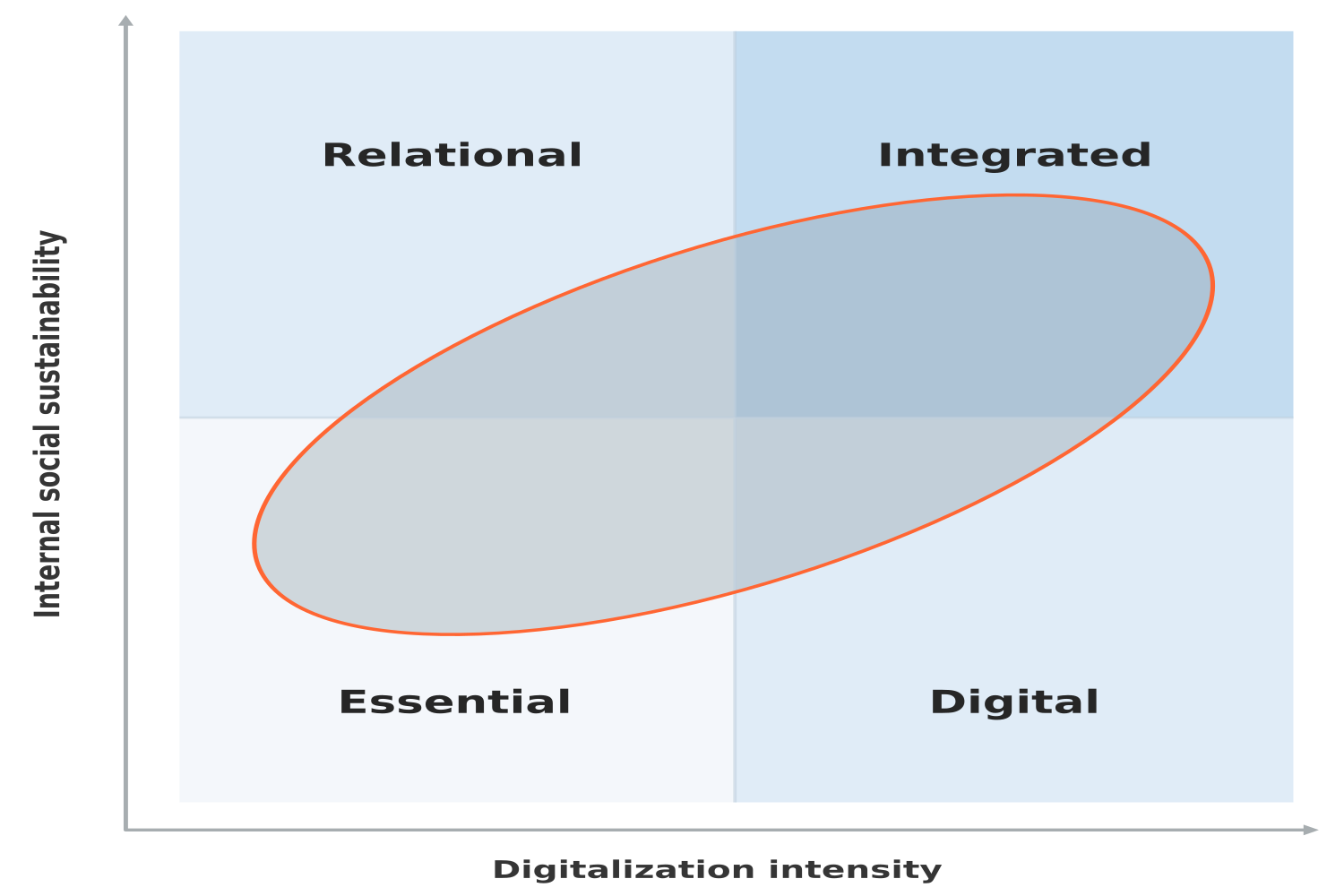
The sample does not allow us to estimate how widespread the observed patterns are, but it does make it possible to identify strengths and areas for improvement, and to formulate practical questions that any company can use to assess its own position.
A focus on people has gained strategic importance. Among the companies studied, social sustainability, employee welfare, training, and inclusion have generally become part of corporate governance and discussions with senior leadership. These areas are linked to the ability to attract and retain talent, develop skills, and ensure organizational continuity. Employee listening practices are widespread and, in the experiences described, inform initiatives aimed at improving the workplace environment and the organization of work. This evolution, however, leaves the question of effectiveness unresolved. Companies find it easier to describe the initiatives they have launched than the results they have achieved. Consider the crucial issue of training. We know how many hours of training are delivered, but much less about how those hours translate into skills actually acquired, career mobility, or better organizational performance. The next step, therefore, is to understand which investments work, for whom, and with what results.
A substantial gap remains between the adoption of technologies and the ability to assess their effects. Most companies in the sample have a formal digital strategy and use artificial intelligence with varying degrees of sophistication. Their responses point to perceived benefits in process efficiency, data analysis, and decision support. However, the impact on employment is difficult to assess because two-thirds of the companies do not disclose data. This does not demonstrate that such impact is being overlooked within organizations, but it prevents the identification of a common trend.
Skills are the main point of convergence between the two transformations. Upskilling and reskilling programs are widely available, but they differ in their level of development and in how effectively their outcomes are measured. The interviews also highlight the need to anticipate how roles should evolve. As tasks and decision-making processes change, responsibilities, collaboration, and career paths must also be reconsidered.
AI governance reflects this transition. Many companies have established, or are in the process of establishing, dedicated rules and are involving technology, human resources, legal, and compliance functions. The spread of AI tools is therefore accompanied by the development of safeguards for security, reliability, and the protection of people, although levels of maturity still vary.
Within the sample, more digitally advanced companies also demonstrate a more structured approach to social sustainability. This is an exploratory finding that offers useful directions for more in-depth future research. The main value of the analysis, however, lies in highlighting potential imbalances: a company may have advanced technologies while still having room to improve its organizational practices, or it may have developed strong people-focused policies whose value could be further enhanced through more mature digital processes.
Design, coordination, and measurement
For business leaders, the first implication is to treat every technological investment as a decision about work as well. Before introducing a new tool, companies in the "integrated" quadrant ask themselves which activities will change, what skills will be needed, how responsibilities will be distributed, and which employees will require additional support. The effort is therefore directed toward overcoming organizational silos and building a genuinely integrated approach to people and technology.
The second implication concerns coordination. Training, employee welfare, innovation, and organizational development may have aligned objectives on paper while remaining disconnected in practice. Cross-functional responsibilities and shared criteria are needed to determine whether initiatives reinforce one another. A digital training program, for example, becomes meaningful when it is connected to changing job responsibilities and concrete opportunities to apply newly acquired skills.
The third step is to measure what actually changes. Training hours, applications introduced, and services made available describe a company's efforts. Assessing the results also requires examining skills actually developed, career mobility, quality of work, and the ability to use new tools. Comparable indicators, such as those identified by the Social & Digital Matrix, if monitored over time, help capture what matters, support continuous improvement, and determine where resources should be concentrated.
The companies studied have already embarked on this journey. They must now ensure that technology and people advance together, because it is this balance that determines their ability to turn innovation into lasting value.
Clio Gressani, Francesco Perrini, Roberta Pisani, Enrico Sassoon. Persone e tecnologie: percorsi di crescita condivisa. Come si posizionano le imprese italiane tra sostenibilità sociale, digitalizzazione e IA. Report Harvard Business Review Italia.


